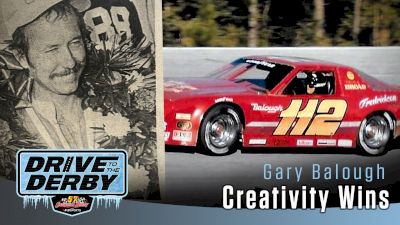
It was a time when technical inspection was minimal, creativity was encouraged, and the rules— for lack of a better word—were bendable.
What unfolded in 1980 at the World Series of Asphalt Stock Car Racing at New Smryna Speedway was nothing short of unbelievable.
- Updated Entry Lists For The 2026 New Smyrna World Series
- Carson Hocevar Enters Clyde Hart Memorial At New Smyrna Speedway
- Here's More Information On How To Stream New Smyrna World Series
Night One
To set the stage, imagine the reaction when Gary Balough unloaded his infamous No. 112 at New Smyrna Speedway. The short track racing world hadn’t seen much of Balough in 1979, as he’d been testing his limits in the NASCAR ranks. But he arrived in Florida determined to make a statement, and he brought a formidable machine with him.
During time trials, Balough stunned the field by laying down a lap a full two-tenths of a second quicker than Junior Hanley, who had built both of the top competitors’ cars. Mike Eddy was third, another tenth back, while Dick Trickle qualified fifth, which was nearly half a second off the pace.
Regardless of home-track advantage, you don’t outrun Dick Trickle by half a second without raising eyebrows.
Balough went on to dominate the opening 25-lap feature and finished second in the Modified 25. Around the pits, the question quickly became: How do we catch him?
With relaxed rules and a wide-open rulebook, bodies began to transform. Scoop-style cowcatchers appeared on noses, and high-backed wings rose above rooflines as teams searched for any advantage.
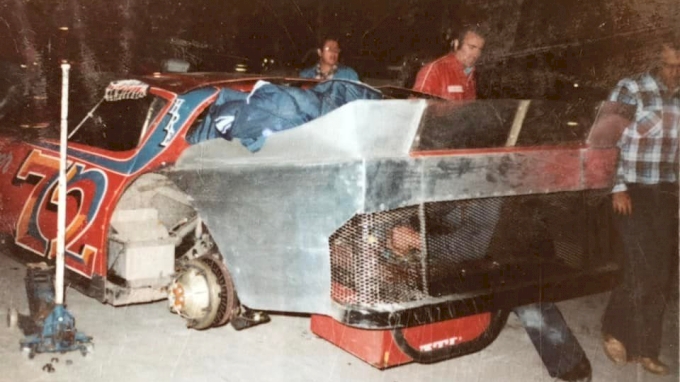
Teams were doing everything and anything in an attempt to beat Gary Balough in 1980.
Night Two
Mark Martin edged Balough on track in time trials—the only time all week the Floridian would be beaten. But in the end, Balough captured the night’s feature, taking the lead with nine laps remaining.
Night Three
Balough started from the pole and led all 25 laps. By now, every scrap of sheet metal in the New Smyrna area had been claimed as teams pushed creativity to its limits in an effort to keep pace.
During this stretch, Super Late Models were actually faster than the Modifieds—a remarkable feat considering that hadn’t been the case for nearly 40 years. Balough, running a Modified, narrowly missed victories early in the week, finishing behind Geoff Bodine and Richie Evans on the first two nights.
Night Four and Beyond
Back in the Late Models, Balough won the pole on night four and backed it up with yet another victory on Monday.
On Tuesday, he set a track record with a blistering 17.62-second lap. To put that in perspective, it was quicker than some Super Late Model pole times recorded decades later.
Balough capped the night by winning his fifth consecutive race—the first driver to accomplish that feat. It would take 10 years before anyone matched it, fittingly accomplished by car builder Junior Hanley.
The Turning Point
On night six, Balough once again won the pole and was leading the race. A season sweep seemed inevitable—until disaster struck. The No. 112 slammed into the wall in a violent crash. Balough broke his neck, ending both his night and his World Series.
In his book, Balough later explained that he had struggled to see around Dick Trickle, whose rear wing sat so high it blocked Balough’s mirror. The two cars came together, triggering the crash. Though he initially felt okay, Balough soon realized the severity of his injuries as the adrenaline faded.
Aftermath and Legacy
With Balough sidelined, Junior Hanley captured the win, while Dick Trickle took the following night. Joe Shear won the final two races, and with six podium finishes, Hanley secured the championship. Had Balough simply taken the green flag over the final three nights, he still could have factored into the title fight.
While Balough never completed his Speedweeks masterpiece, the story found a fitting epilogue that December.
Balough brought the iconic No. 112 to Pensacola and put it on the pole for the Snowball Derby with a track record that stood for more than 30 years. He went on to win the race on Sunday in a field that still resembled the New Smyrna “Wild West.”
By 1981, however, the rules were tightened and enforced, bringing the wild-card era to a close that Sunday at Five Flags Speedway.