
With the SageNet Center packed full of 2,000+ entries, a record-shattering number, the 41st Tulsa Shootout requires a precise run of show to chop down monstrous numbers like almost 500 cars in one class to merely 24 feature starters in only a few days' time.
Last year, with 1,798 entries on hand, the “Mecca of Micros” held 389 races over five days - including 188 Heat Races, 24 E-Mains, 32 D-Mains, 44 C-Mains, 44 B-Mains, 46 Qualifiers, 5 LCQ’s, and 6 Championship A-Mains. Ultimately, the Tulsa Expo Raceway surface conducted a record 3,734 green flag laps when it was all said and done.
- NASCAR Drivers Racing In The 2026 Tulsa Shootout
- 30 Favorites To Win At The Tulsa Shootout
- Here's More Information On How To Stream The Tulsa Shootout
This year, thanks to the record growth, the event format will expand extensively to 433 races over five days - including 209 Heat Races, the addition of 24 F-Mains for the first time ever, 24 E-Mains, 32 D-Mains, 45 C-Mains,45 B-Mains, 46 Qualifiers, 6 LCQs, and 6 Championship A-Mains - elevating the lap count to 4,078 green flag laps.
Now, you are probably asking how on earth is it possible to get all this done in such a timely manner? Well, passing points is the name of the game.
The easiest description of the passing points chart (included below) can be broken down by finishing points AND THEN passing points. By position, drivers earn 100 for 1st - 93 for 2nd - 86 for 3rd - it’s a 7-point drop per spot. Then, you add in passing points, which is +5 for every position advanced and -1.5 for every position lost.
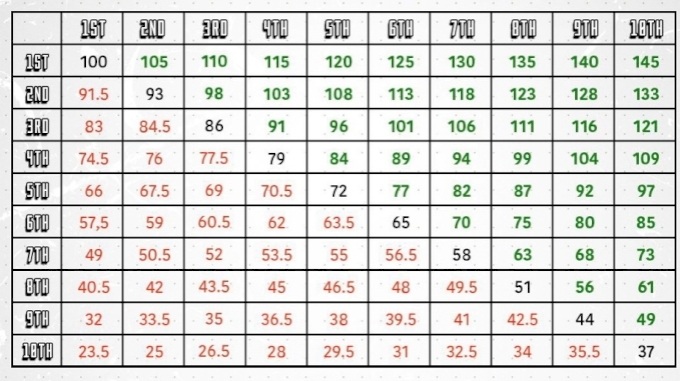
It all starts with a pill draw, ironically one of the most important moments of the week. The four major divisions feature north of 40+ Heat Races, thus creating a huge divide in passing points and plenty of crucial tiebreakers. Some will win from the pole, others will charge from 8th, there will be those losing spots, and generally every situation occurs at least once.
Following Heat Races, the top 112 in passing points advance to 8 Qualifiers (14 cars in each) with a four-car inversion in effect. That’s where the bubble gets more intense, with the top-32 points-getters involved in said inversion. Thus, high point man starts 4th in his Qualifier with ample opportunity to gain more points. The hardcore cutoff is that line between 32-33, which is the difference between starting on the pole and starting 5th.
Those missing the cut for Qualifiers are sent to F-Mains, E-Mains, D-Mains, and C-Mains to begin their alphabet soup bids.
In Qualifiers, which are often some of the most intense races of the week, drivers fight for more passing points. When its all said and done, only the TOP 16 in combined points will lock-in for their respective main event. Drivers 17th-112th split into 8 B-Mains, and from there, the Last Chance Qualifier sends the final eight drivers into the big dance.
Once the full 24-car field in each division is set, it’s game on Saturday night. With the iconic Golden Driller on the line, you never know what to expect come main event time.
With car count numbers rising, we’ve seen some crazy passing point numbers be posted over the years - such as last year’s Stock Non-Wing A-Main setting the all-time record for top-16 cutoff at 218 PTS. Simply put, you truly need a bit of luck on your side at the Tulsa Shootout, but you still better be on your A-game every time you roll onto the track.
FloRacing is the official live streaming partner of the Tulsa Shootout, which officially begins on Tuesday, December 30 with Heat Races all day. The event continues all the way through Saturday, January 3 when six Golden Drillers are decided.
FloRacing subscribers gain full access to the Tulsa Shootout, Chili Bowl Nationals, High Limit Racing, Lucas Oil Late Model Series, USAC Racing, and so much more