The Greatest Spectacle in Racing is synonymous with interesting statistics and never-ending fun facts. This year's 109th Indianapolis 500 presented by Gainbridge on May 25 at Indianapolis Motor Speedway is no different.
Rookie Robert Shwartzman, the first Israeli driver in the race’s history, stunned the field by clinching pole position at 232.790 mph, becoming the first rookie to do so since 1983. With a field average speed of 231.207 mph — the third fastest ever — and eight former winners, including four-time champion Helio Castroneves, the stage is set for a high-octane 200-lap showdown.
From the record-breaking 677 laps led by Scott Dixon to the deepest-ever winning start position of 28th, the Indy 500’s legacy of speed and surprises endures. Let's break down this year's Indy 500 by the numbers.
- Indy 500 Starting Lineup 2025: See Who Starts Where
- Industry Reacts To Penske's Major Indy 500 Penalties: 'This Is Devastating'
- Indy 500 Odds 2025: Here Are The Betting Favorites After Qualifying
Indy 500 By The Numbers: Statistics And Fun Facts
0: The number of grandstand tickets left, marking a complete sellout for reserved seats.
1: Rookie Robert Shwartzman earned his first career Indianapolis 500 pole and is the first rookie to win the pole since Teo Fabi in 1983. Shwartzman, born in Tel Aviv, Israel, is the first Israel native to compete in The Greatest Spectacle in Racing as well.
- Tony Stewart, a rookie then, did start from the pole in 1996, but he qualified second and moved to the pole position after his teammate Scott Brayton suffered fatal injuries in a crash during post-qualifying practice.
- This is the first time car No. 83 has won the Indianapolis 500 pole.
- FOX’s first Indy 500 broadcast introduces augmented reality graphics and a dedicated “IndyCam” for in-car driver perspectives, a feature not used since ABC’s coverage in the early 2000s. The broadcast will also include a pre-race performance by Luke Combs, a first for the Indy 500.
3: The number of rookies in the field, the number of drivers in the field who didn't start the 2024 Indy 500, and how many rookies have now won the pole at the Indy 500.
- Robert Shwartzman (starting first), Louis Foster (20th), Nolan Siegel (24th). There were six rookies in the 2024 field. The last race with fewer than three rookies was 2021 (Scott McLaughlin, Pietro Fittipaldi).
- Other than the three rookies, David Malukas, Devlin DeFrancesco and Jack Harvey are the drivers in the field who didn’t start the race in 2024. All three made their last start in 2023.
- Shwartzman is the third rookie to win the pole on track. The others: Walt Faulkner (1950), Teo Fabi (1983). Lewis Strang started from the pole for the inaugural 500 in 1911 when starting position was determined by entry postmark date. Jean Chassagne started from the pole in 1914 when starting position was determined by a draw.
4: The number of drivers in the 2025 field who have won the IndyCar Series championship.
- Scott Dixon (6 titles: 2003, 2008, 2013, 2015, 2018, 2020), Will Power (2: 2014, 2022), Ryan Hunter-Reay (1: 2012), and Alex Palou (3: 2021, 2023, 2024). This ties the record for most series champions in a single Indy 500 field, previously set in 2008 and 2018.
6: The number of crashes during Indy 500 practice and qualifying.
7: The least-experienced Indy 500 row is Row 7, with four combined career starts (Kyle Larson 1, Louis Foster 0, Callum Ilott 3).
8: The amount of former Indianapolis 500 Rookies of the Year in this year’s field: Marco Andretti, Helio Castroneves, Santino Ferrucci, Ryan Hunter-Reay, Kyle Larson, Scott McLaughlin, Pato O’Ward, Alexander Rossi. The record is nine, in 1991 and 2021.
10: The most-experienced row in this year’s starting lineup is Row 10, with a combined 37 career starts (Graham Rahal 17, Marco Andretti 19, Marcus Armstrong 1).
11: The 2025 field is one of the most diverse, with drivers from 12 countries, including first-time representation from Israel (Shwartzman). This matches the record for most nations represented, set in 2020.
- United States: Drivers include Kyle Larson (Arrow McLaren), Graham Rahal (Rahal Letterman Lanigan Racing), Santino Ferrucci (A.J. Foyt Racing), Josef Newgarden (Team Penske), Conor Daly (Juncos Hollinger Racing), Ed Carpenter (Ed Carpenter Racing), Ryan Hunter-Reay (DRR-Cusick Motorsports), Marco Andretti (Andretti Global), Colton Herta (Andretti Global) and Nolan Siegel (Dale Coyne Racing).
- Israel: Robert Shwartzman (Prema Racing), the pole-sitter and first Israeli-born driver to compete in the Indy 500.
- Japan: Takuma Sato (Rahal Letterman Lanigan Racing), a two-time Indy 500 winner (2017, 2020).
- Australia: Will Power (Team Penske), the 2018 Indy 500 winner.
- New Zealand: Scott Dixon (Chip Ganassi Racing) and Scott McLaughlin (Team Penske), with Dixon holding the record for most laps led (677).
- Brazil: Hélio Castroneves (Meyer Shank Racing), a four-time Indy 500 winner.
- United Kingdom: Louis Foster (Andretti Global, rookie), Callum Ilott (Arrow McLaren), and Jack Harvey (DRR-Cusick Motorsports).
- Spain: Álex Palou (Chip Ganassi Racing), the back-to-back IndyCar Series champion.
- Mexico: Pato O’Ward (Arrow McLaren), starting third in the No. 5 Chevrolet.
- Canada: Devlin DeFrancesco (Rahal Letterman Lanigan Racing).
- Netherlands: Rinus VeeKay (Dale Coyne Racing), who secured the final spot in the field during Last Chance Qualifying.
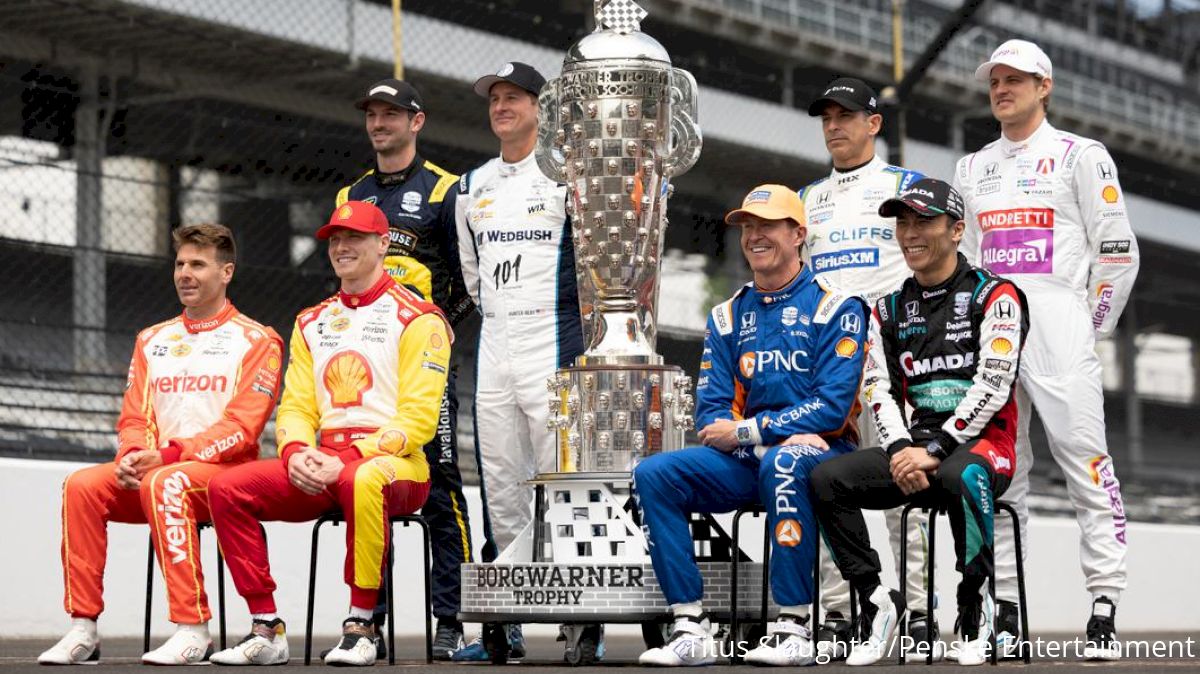
13: The amount of combined victories between the eight former Indianapolis 500 winners in the starting field: Helio Castroneves (2001, 2002, 2009, 2021), Scott Dixon (2008), Ryan Hunter-Reay (2014), Alexander Rossi (2016), Takuma Sato (2017, 2020), Will Power (2018), Marcus Ericsson (2022), Josef Newgarden (2023, 2024).
- The record for most former winners in the field is 10 in 1992. The fewest, other than the inaugural race in 1911, is zero in 1912, 1913, 1915 and 1916.
15: Helio Castroneves will become the 15th driver age 50 or older to start the Indianapolis 500.
- The others: Mario Andretti, Cliff Bergere, Gary Bettenhausen, Duane Carter, A.J. Foyt, Ralph Hepburn, Gordon Johncock, Jim McElreath, Danny Ongais, Johnny Rutherford, Johnny Parsons, Lyn St. James, Dick Simon, Al Unser.
20: The youngest driver is Nolan Siegel, 20 years, 197 days.
- Nolan Siegel, Kyffin Simpson and Louis Foster will be younger on Race Day than Troy Ruttman when he became the youngest winner of the Indianapolis 500 in 1952 at age 22 years, 80 days old. Outside of Siegel, Simpson will be 20 years, 228 days with Foster 21 years, 302 days.
- A.J. Foyt IV is the youngest driver to start the Indianapolis 500 as his 19th birthday was on race day in 2003.
24: Helio Castroneves is the most experienced driver in the field, with 24 previous Indianapolis 500 starts.
- The record is 35, set in consecutive years from 1958-1992 by A.J. Foyt.
28: The deepest starting position for a race winner is 28th, by Ray Harroun in 1911 and Louis Meyer in 1936. Two-time reigning winner Josef Newgarden is starting 32nd this year.
29: The number of Indy 500 wins by teams owned by Roger Penske, including Josef Newgarden’s back-to-back victories in 2023 and 2024.
32: Where defending winner Josef Newgarden starts after being penalized for using a modified attenuator in qualifying. No Penske driver has won from deeper than 19th in Indy 500 history.
50: The oldest driver in the starting field is Helio Castroneves, 50 years, 15 days on Race Day. He's the first driver age 50 or older to start in the Indianapolis 500 since Lyn St. James in 2000.
- A.J. Foyt is the oldest driver to start the Indianapolis 500 at 57 years, 128 days old when he made his last start in 1992.
- Castroneves and Takuma Sato will be older on Race Day than Al Unser when he became the oldest winner of the Indianapolis 500 in 1987 at age 47 years, 360 days old. Castroneves will be 50 years, 15 days old on Race Day; Sato 48 years, 117 days.
- The 2025 race marks the 50th anniversary of the first Indy 500 broadcast on closed-circuit television in 1975, a milestone FOX broadcast partner will highlight with a retrospective segment during the pre-race show.
68: The record number of lead changes at the Indy 500 set in 2013.
120: How much extra horsepower teams through energy regeneration via IndyCar's hybrid energy recovery system, adding a strategic layer to pit stops and overtaking, especially on the 2.5-mile oval. The 2025 Indy 500 is the first to fully integrate IndyCar’s hybrid engine, introduced July 2024 at Mid-Ohio Sports Car Course.
200: The number of laps in the Indy 500, covering 500 miles. The fastest race completion time in history was 2 hours, 40 minutes, 3.598 seconds by Helio Castroneves in 2009, averaging 187.433 mph. With 2025’s hybrid system, teams may push for a new record.
231.207: The field average speed in mph, the third fastest in history. The fastest is 232.184 in 2023, followed by 231.943 in 2024.
253: The combined previous Indianapolis 500 starts among the 33 drivers in this year’s field. The record is 260 years of experience, set in 1987 and 1992. There were 222 years of combined experience in last year’s field.
677: Career laps Scott Dixon has led in the Indianapolis 500, the all-time event record. The only other driver in the field who has led more than 200 laps is Helio Castroneves (326).
1911: The year of the inaugural Indy 500, won by Ray Harroun at an average speed of 74.602 mph. The 2025 field’s average speed of 231.207 mph is over three times faster, showcasing the evolution of IndyCar technology over 114 years.
1996: Prema Racing, a powerhouse in European motorsports, is the first team since Rahal Letterman Racing in 1996 to win the Indy 500 pole in their debut season. Their driver, Robert Shwartzman, qualified with a four-lap average of 233.939 mph, the fastest pole speed since 2023.
2,575: How many laps led among 25 different drivers in this year’s field across previous Indianapolis 500s.
350,000: IMS reports pre-race ticket sales projecting over 350,000 attendees, the highest since 2016’s sellout.
18,456,000: The purse of last year's Indy 500 as winner Josef Newgarden pocketed $4.288 million.