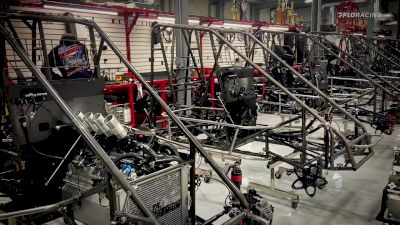
Keith Kunz has spent a lifetime preparing race cars for other people’s futures. Now, the 63-year-old car owner whose midget program helped develop some of auto racing’s biggest stars is making room for his own.
Kunz confirmed in an interview with DIRTVision’s Connor Wade that Keith Kunz Motorsports will cease operations following Nov. 27-28’s USAC season finale at Ventura (Calif.) Raceway's Turkey Night.
The announcement follows mounting speculation about the team’s future, fueled by the listing of its Columbus, Ind., race shop for $2.95 million. The closure will end the dynasty built by the team simply known as KKM, whose résumé includes eight Chili Bowl Nationals victories, 11 USAC National Midget titles and more than 200 USAC national feature victories.
Kunz emphasized, however, that he intends to remain involved in the sport.
“I don’t want to say it’s retirement. It’s semi-retirement,” Kunz said. “I’m still going to be around.”
For Kunz and longtime partner Pete Willoughby, the decision follows years of considering when and how to step away.
Partway through this season, they decided to close the operation at year’s end, then identified a finish line: Finish the year and pursue another championship, with Jacob Denney leading the USAC National Midget standings by 73 points with seven races remaining.
“I’ve been slowing down the last couple years just because of, physically, I can’t keep up with these young kids no more. I’m not 20, 30 years old,” Kunz said. “I’m not that old, 63. But to be hands-on and do it like you need to do, I just can’t keep up. I can’t do that no more, and I don’t want to do that no more.
“I like spending my time with my family and kids now. I never got to do that when they were growing up.”
Kunz said he tires more easily in the heat and has needed additional personnel as he and Willoughby have become less hands-on. Time spent with his daughter and grandchildren has given him another reason to loosen racing’s grip on his schedule.
“I just don’t want that commitment of having to go every week and be there. And I want to be able to say, ‘I want to go this week,’ or, ‘I want to go spend time with my kids,’” Kunz said. “I’ve been doing a lot of rodeo stuff with my daughter and the grandkids now, and I’m enjoying that stuff. So it’s a retirement, but I’m still going to be around.”
That means no KKM cars or trailers at the next Chili Bowl, an absence that will be especially striking given Kunz’s deep-seated connection to the Tulsa event.
He attended his first Chili Bowl in its second year, 1988, and said he has returned every year since. Over time, his operation worked its way from farther back in the building to the prominent parking position that became part of its identity.
More significantly, Kunz credits the Chili Bowl with changing his professional life. Winning with Andy Hillenburg in 1994 helped create the opportunity to move to California and work on midgets full time.
“That place has really been good to me. It probably made my career,” Kunz said. “In ’94, when we won that with Andy Hillenburg, that was a turning point. … I moved to California and started working on midgets full time. So, you know, that place made my life.”
He recently called Chili Bowl co-founder Emmett Hahn to explain the decision and thank him for the support he has received over the years.
“I called Emmett a couple weeks ago and explained to him what was going on and thanked him,” Kunz said. “He told me anytime I want to come back, I’ll be VIP.
“I’ve got things going on. Like I say, it’s not the end of racing. It’s the end of KKM, so you’re not going to see the trailers and the cars there this year. But I have a lot of people that’s reached out to me already and want me to be involved in different things, and I’m considering all that. We’ll see. We’ll see what the future brings.”
Kunz plans to retain a couple of micro sprints at home and continue working with Tulsa-based driver Jeffrey Newell at selected events.
“I’m going to take my micro stuff, keep a couple micros at home, just pick and choose what I want to go run,” Kunz said. “I’ve been running with Jeffrey Newell here lately and really had a lot of fun with him and success. He’s kind of at the top of his game. So me and him have talked about, you know, we’ll run certain races whenever I want to and he wants to.”
Kunz also plans to assist 4 Kings Racing’s sprint car program, building on his relationships with owner Rex Turner and driver Kevin Thomas Jr.
“I’ve been good friends with Kevin Thomas for a long time,” Kunz said. “Rex Turner, who’s the owner of 4 Kings, I’ve helped him since day one.”
A proposed director of competition role would give Kunz an opportunity to help the team grow while retaining control over his schedule.
“Rex reached out to me and asked me to maybe come hang out with them as little or as much as I want to,” Kunz said. “Kind of said, ‘We’ll make you a director of competition,’ and you can kind of just be another set of eyes and ears and another voice to help their team grow.
“They want to expand to a couple more cars next year, and their team’s growing. They’ve got sponsorship and stuff like that lined up, and they’ve asked me to be a part of it. So I said, ‘Yeah, I’ll come and be as much help as I can.’ If I can’t come, they’re fine with it.”
Kunz sees potential for the operation to establish a lasting presence in USAC while offering him a less demanding role.
“Somebody needs to kind of step up in the USAC thing and be that next team that’s going to be around for a while, and I think that’s what they are,” Kunz said. “I’m looking forward to working with them guys a little bit and see how it goes.”
For Kunz, the appeal also lies in contributing without carrying the full responsibility of ownership.
“It’ll be a different aspect for me,” he said. “A lot of the pressure and responsibilities are off my shoulders.”
Those responsibilities have become more complicated as the economics of driver development have evolved.
KKM’s partnership with Toyota Racing Development, which Kunz said began in 2009, helped establish the operation as a proving ground for emerging talent. Its success with drivers such as Kyle Larson and Christopher Bell drew families seeking a route toward racing’s highest levels, including the NASCAR Cup Series.
While funded drivers helped sustain the operation, Kunz emphasized that several of its most accomplished graduates were hired for their talent.
“Kyle, Christopher, Buddy Kofoid — none of them guys brought money,” Kunz said. “They were hired guys that we could see that had talent.”
He also cited his work with Tony Stewart before Stewart became a household name, along with two-time High Limit Racing champion Rico Abreu and Chili Bowl Nationals champion Tanner Thorson.
“I watch an Outlaw race and I can see 10 guys in the feature on any given night that came here for a little while,” Kunz said. “Very proud of it, very proud to know those guys.
“Along with that, you always get people that come along and want to give their kids that shot, and we do that. That was kind of how we survived over the years.”
But Kunz said the developmental path has shifted. Young racers are gaining extensive micro experience, allowing some to move directly into sprint cars rather than spending time in midgets.
“All of our kids came through micros, basically, at some point there, and we really kind of focused on that,” Kunz said. “Now the last few years, these kids have so much experience by the time they’re 16 years old that they’re just going straight into Sprint Cars, and they can handle it, where before they couldn’t handle it, so they had to have that steppingstone.
“Now the kids are just lights-out. Owen Larson, Brexton Busch, they don’t need to go (midget) racing. When they get done with their micros and they get to the age, they’re going Sprint Car racing.”
Rising costs and broader economic pressures have also affected the business. Kunz acknowledged those factors influenced the timing, even as he characterized the closure as a positive decision made on his terms.
Toyota supported the decision, Kunz said, despite several years remaining on the team’s contract. He credited Jack Irving and Tyler Gibbs for their support, saying Toyota’s willingness to work with him extended to a potential smaller operation run from home.
“They were happy for us. They understood. I think they could see it coming, but they totally understood,” Kunz said. “They were so thankful, and I’m so thankful for Jack Irving and Tyler Gibbs and them guys.
“They’ve given us everything that we could ever ask for. … I talked a little bit about, ‘OK, maybe I go and run a car out of my house and run 10 races next year.’ They’re like, ‘Whatever you do, we’ll be a part of it.’ ”
Asked what he treasures most, Kunz praised the people he's worked with rather than a particular victory.
“I’m just a guy from Illinois that’s been very lucky,” he said. “I think that’s probably what I’m proudest of, is the names … to be associated with all that.”
For the next chapter, home already offers much of what he wants. Kunz lives on 25 acres near Hoosier National Forest, where he can hunt, help care for his daughter’s horses and host the grandchildren.
“We really enjoy it out there in no man’s land,” Kunz said. “We’re pretty happy out there.”
Racing will remain part of that life, just with fewer obligations.
“It’ll keep going,” Kunz said. “I’m just glad to be a part of it all the years.”