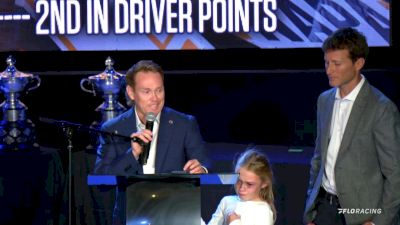
Brad Sweet discovered something about life after full-time racing that he couldn't have truly known otherwise.
As the six-time national champion entered his first season no longer racing for a living, a part of him wasn't ready to relinquish driving altogether. He agreed to a limited schedule with venerated car owner and crew chief Paul Silva centered around the Kings Royal and Knoxville Nationals. How could he not explore that sterling opportunity?
Three futile nights during Kings Royal week at Eldora Speedway, however, changed everything.
After scratching from the Knight Before the Kings Royal on July 17 because he simply didn't feel comfortable behind the wheel, Sweet realized his uneasiness revealed a deeper truth.
He could no longer give Sprint Car racing's biggest events the competitive commitment they demand.
That realization ultimately led him to withdraw from the Knoxville Nationals, end his deal with Silva and, by every indication, turn what could be the final laps of his Hall of Fame-bound driving career.
"Ultimately, you don't know how you're gonna feel when you retire from full-time racing," Sweet told FloRacing in a phone interview Tuesday. "You invest your whole life into racing trying to achieve your goals of winning championships and big races. Making a living racing was always my goal as a kid, and I never imagined I'd have as much success as I did.
"I think as you get older — kids, family — your time becomes very important to you. What it takes to be competing at the highest levels, it's just no joke out there. You don't just show up and kind of half-ass it, especially when you're driving for someone like Paul Silva and his team with Trevor Canales. They're working as hard as anybody out there and put the time and effort in. And so, it's just not fair.
“If you're a Sprint Car racer, you're trying to win the race or you're not," Sweet added. "That's how I look at it.
For Sweet, the decision wasn't about a lack of confidence in his ability alone, but where racing fit in his life. Ironically, he was enjoying one of the more productive seasons of his career, winning four of his 17 starts (23.5 percent) — his highest win rate since capturing 17 victories in 82 races (20.7 percent) in 2021.
Three of those victories came in NARC competition, but the other served as a reminder that Sweet remained capable of beating the sport's best. He topped a 60-car World of Outlaws field at Knoxville Raceway in April, a triumph against a Crown Jewel-caliber field that accentuates the decision to step away wasn't about ability. It was about priorities.
“I'm not saying that I'm not capable. What I’m saying is I'm not showing up to the racetrack with that 110 percent commitment,” Sweet said. “And, you know, putting the work in behind the scenes that you have to, especially to try to win the race.”
That commitment goes well beyond race day.
“It's studying the film, it's working out, it's being in race shape, it's mentally being all in on making the right moves,” Sweet said. “The intensity gets ramped up at these big races. Sometimes I show up and get lucky. Could I run up front at the Knoxville Nationals? Yeah. But that's still not fair to go into it that way. I think that I just hold myself to a little higher regard than that.”
Following finishes of 16th and 17th during the Joker's Jackpot and a scratch after time trials on July 17, an honest conversation with Silva at Eldora turned that realization into a decision.
“Ultimately the conversation at Eldora, I give Paul credit for making me have that difficult conversation,” Sweet said. “Not that he pressured me one way or the other. He just wanted me to be honest, because, obviously, he could tell I wasn't that comfortable. I was out of it. He got the feeling just based off my mannerisms that, you know, I wasn't really enjoying it.
“Also, the conversation we had was great. I still respect the s--- out of Paul and have a good friendship with him. I’m able to kind of step away, and it gives them clarity on their path forward and clarity on my path forward.”
As Interstate Batteries High Limit Racing and NARC continue to grow, so do Sweet's responsibilities as co-owner of both series. Add in his role as promoter of Silver Dollar Speedway and, most importantly, his family, and racing no longer occupies the same place in his life.
Last year's violent Kings Royal crash at Eldora only reinforced that outlook. Sweet hit the wall and flipped before an oncoming car slammed into him driver's side first. He was sidelined for 15 days with a concussion and required a medical provisional to return for one High Limit event.
“I think the Eldora crash last year put a lot of things in perspective for me,” Sweet said. “So there's no doubt that expedited some of my decision-making just going through that process of, you know, making a mistake, having another car run into me, and kind of having a major concussion. There’s more to life sometimes than driving a race car. There's no doubt if you're not all in with these things, you better be willing to take that risk when you go out there and race.
View this post on Instagram
“No matter how safe things are in any race car, there's an element of danger that goes with that, and so, if you're not willing to accept that, you just gotta be true with yourself," he added. "I think that’s what I kind of came to the conclusion of.”
Devising an exit strategy — or a retirement plan — as a Sprint Car driver, or any racer for that matter, is rarely straightforward. Every career follows a different path. Steve Kinser raced until he was 62. Doug Wolfgang retired at 45 after a series of major crashes convinced him it was time to step away.
Daryn Pittman retired from full-time driving at 42 in 2020, though this season marks his sixth year racing on a limited schedule. Sammy Swindell, meanwhile, is still competing at 70 and is entered to make a record 50th Knoxville Nationals start this week.
To Sweet’s point, there's no universal formula for knowing when the time is right.
"It's different for everybody. That's the thing, there's no book on where and how you should end your racing career," Sweet said. "I don't have an opinion on anybody else's decisions. It's just, I care about my family, my decisions. I don't care if people race 'til they're 70 years old. If that's what they want to be doing, that's what they want to be doing. That's on their terms. Everybody's built different. Everybody has different goals. And as you get older, you realize the importance of time and how you spend your time. The moves that I make are important to me.”
Asked whether he'd be content never racing again, Sweet made his feelings clear.
“Look, I don't have anything to prove, and whatever decision I make, I don't have to explain it to anybody. That’s the beauty of it,” Sweet said. “I don't owe anybody anything. I contributed to the sport more than I could possibly imagine. I've had the opportunity to meet and win and build relationships with so many great people in Sprint Car racing. It's done so much for me and my family. The High Limit contributions continuing — there’s so much that I'm proud of.
“If I don't race again, I don't race again. If I decide I want to race again sometime, then I'll race again. You know, I don't feel the need to. When I retired from full-time racing, I didn't know what that meant. Well, it meant I was gonna run 17 races this year and possibly be done, or I just don't know.
“Right now, I didn’t feel comfortable at Eldora, so I pulled out of it. I don’t think I’m going to Knoxville because I don’t want to race Knoxville at that level.”
Sweet, of course, will still be at the Knoxville Nationals — the event he won in dramatic fashion in 2018 — but this time as an ambassador for the sport rather than a driver. And that's exactly how he wants it.
"I had a hell of a career, and I had my time, you know, where I rose to the top of the sport and accomplished all my goals. Now I kind of feel like I have nothing to prove," said Sweet, the 107-time national tour winner whose 93 World of Outlaws triumphs rank 10th all time. "I was able to, along the way, position myself that I get to make this decision on my terms. With some of my business decisions on the other end, I don't have to race for a living. I have a beautiful family. I have a lot of life in front of me.”