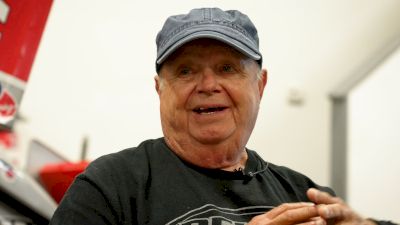
National Sprint Car Hall of Famer and Shark Racing owner-founder Bobby Allen, whose rags-to-riches story is among dirt racing's most compelling, died Sunday. The Hanover, Pa., native was 81.
The National Sprint Car Hall of Fame, among other platforms, confirmed his passing Monday. A cause of death wasn't immediately made known.
Affectionately known as "Scruffy," a nickname given to him by Lynn Paxton for his shaggy hair and race cars that'd go prolonged periods without fresh paint, his Sprint Car career amassed more than 276 victories from 1967-98.
His 30 victories on the World of Outlaws Sprint Car Series are 24th all-time. No victory as a driver was bigger than his 1990 Knoxville Nationals triumph, which is widely regarded as the greatest upset in Sprint Car racing's grandest event at Knoxville Raceway — a year he finished 13th in the WoO standings.
Since 2008, Allen had been involved owning and managing his family-run team for grandson Logan Schuchart and son Jacob Allen.
Allen did whatever necessary for him and his family to make it in Sprint Car racing as he often slept in pickup trucks, racetrack ticket booths or barns on the property of Williams Grove Speedway to keep his dream of racing full-time in Central PA alive.
As a car owner, Allen's grandson Schuchart won the richest event in short-track racing history July 2023 at the FloRacing-streamed and -backed Eldora Million where his No. 1s team pocketed a life-changing $1,002,023.
He was part of the inaugural World of Outlaws Series in 1978, finishing third that year behind Steve Kinser and Rick Ferkel. He went onto capture seven Sprint Car titles: three at Lincoln Speedway in '67, '69 and '70), Susquehanna Speedway (now BAPS Motor Speedway) in '69, Reading Fairgrounds in '76, the All Star Circuit of Champions in '80, and Ohio Speedweek in '86.
Allen was born Dec. 28, 1943, in Miami, Fla., growing up the son of stock car racer Joseph Allen, who eventually became a U.S. Army pilot and member of the Flying Tigers — a group of American volunteer pilots who fought against Japanese forces in China and Burma (now Myanmar) during World War II.
The Shark Racing name actually derived from Allen wanting to pay tribute to his father's service as a Flying Tiger — the military contingent whose P-40 Warhawk fighters featured distinctive shark-mouth nose art.
Bobby began integrating the shark-mouth look on his Sprint Cars after his father died of cancer in the 1980s and his cars still feature the distinct look to this day, namely Ashton Torgerson's No. 1a machine.
One of Allen's first gigs in racing came as a parts boy for Miami-based 1960 Indianapolis 500 winner Jim Rathmann. There he formed dreams of one day racing in the Indy 500, until he moved from Florida to Hanover, Pa., in 1966 to launch his eventual Sprint Car career.
In 1970, Allen attempted to start a life in IndyCar, teaming up with his Sprint Car owner Shorty Emrich to test at Phoenix Raceway. It was a short-lived foray into the discipline because "that car ate up my fortune of $30,000 faster than baked beans will go through an ol' lady," as told by Allen in his 1998 National Sprint Car Hall of Fame induction article.
Foreseeing "no way to make a living doin' that," Allen "buried my Indy dream" to pursue full-time Sprint Car racing as a car builder and driver in Central PA and beyond.
In his 1998 Hall of Fame induction article, two-time Indy 500 starter and 1971 Knoxville Nationals winner Jan Opperman said Allen "really blew my mind" as an innovator, further saying "Allen was into all kinds of lightweight metals, weird chassis deals, tire combos — everything."
Moreover, "he wasn't selfish," the late Opperman said. "He could have ran us all outta the game by keepin' his secrets to himself. But that ain't Allen. He showed us his ways — he helped everybody."
Ferkel, the late Hall of Fame driver who competed with Allen on the inaugural WoO season in 1978, said that "Jan is right. Bob coulda put us all outta the business. Instead, he helped us. One of the most unselfish people I've ever met."