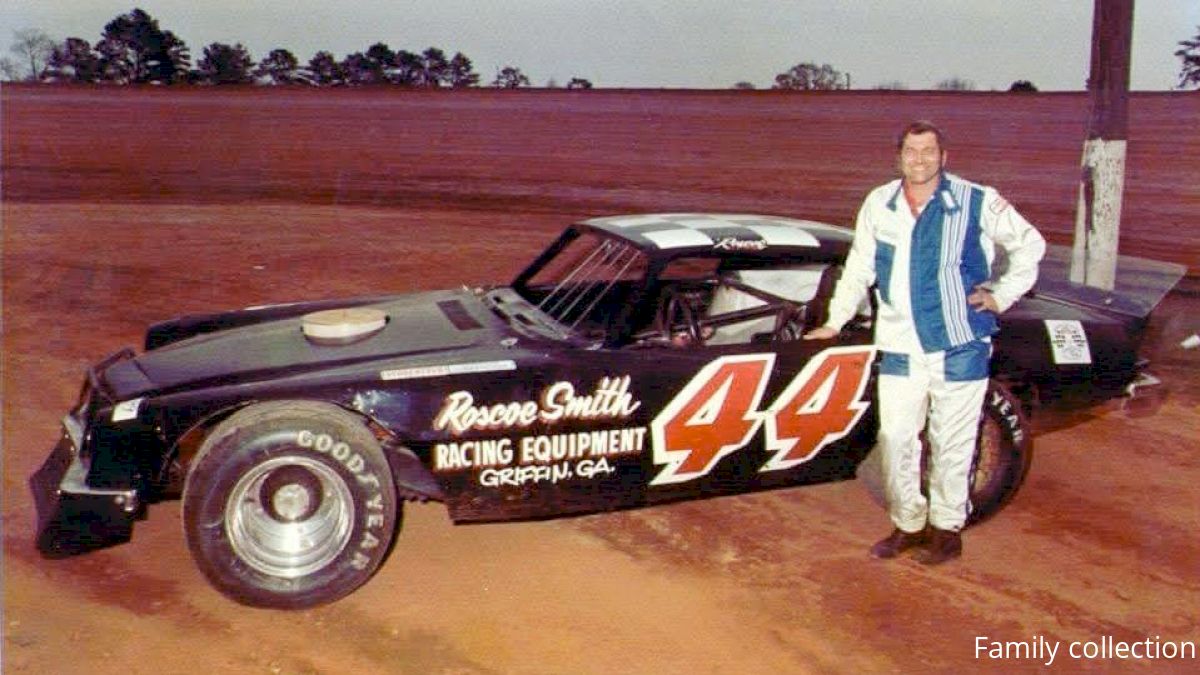
Mark Richards knows Dirt Late Model history like few people in the sport. A solid five decades of deep involvement in the industry — plus an impeccable memory — gives the Rocket Chassis co-owner some serious cachet.
So when Richards, 64, says Griffin, Ga.’s Roscoe Smith, who died Aug. 16 at the age of 85 after being hospitalized for pneumonia, deserves more recognition for his role in the division’s evolution, everyone should sit up and listen.
“I’m gonna say Roscoe was one of the pioneers in the Late Model chassis world, and a lot of people don’t know the whole story,” Richards said of the key developments of the production of Dirt Late Models. “Most people lead back to the (C.J.) Rayburn days, but they don’t know it went beyond the Rayburn days.”
Richards’s Dirt Late Model history lesson for the uninitiated goes back to the mid-1970s, a stretch when the division was beginning to emerge from its early modest, do-it-yourself years. Smith was in the middle of the revolution.
A former drag racer who switched to oval competition in 1969 and became a Dirt Late Model stalwart with his checkerboard-roofed No. 44 cars at Atlanta-area tracks, Smith began building Dirt Late Model chassis at his Roscoe Smith Racing Equipment shop. He took the construction process to a new, higher level, not exactly mass-producing chassis like companies today but certainly bringing more workmanship, consistency and ingenuity to the class.
“The mid-‘70s to the late-‘70s, the fastest cars were coming out of Georgia and that area. They were the type of cars winning at Eldora (Speedway) — in dry conditions, they became better,” Richards said, referring to the famed Ohio track’s World 100. “They were being built in different shops down there. One of the World winners, (1977 victor) Doug Kenimer (of Dalton, Ga.), he built his own cars down there. The Thomas boys at Jig-A-Lo (Chassis), over in Alabama, Phenix City, they were building cars. And there were others, but Roscoe Smith was one of the bigger guys in that area, maybe the biggest.
“It was just a different process. Roscoe, he built GM-type front-end cars that were really fast. He was building really good looking cars. Back in those days, that’s all you heard — ‘Roscoe Smith Race Cars, Roscoe Smith Race Cars.’ ”
At the time, Richards was a teenager learning the mechanical ropes working on cars fielded for an array of drivers by his older brother Roger, who noticed the speed and quality of Smith’s vehicles and decided to purchase one because “he felt you needed to go where the fastest cars were,” Richards said. That brought the young Richards to Smith’s shop, where he was amazed by what he saw — a full-fledged business with multiple employees cranking out well-designed machines.
“You gotta realize, racing at that time wasn’t at the level that it’s become,” said Richards, who also met and befriended Smith’s teenage son, future national touring series regular Clint Smith, during his visits to the Georgia shop. “In my eyes, at 16, 17 years old walking in there, it was a big operation. Nobody was doing (sales) numbers like today, or like we were in our heyday (at Rocket) doing 300, 350 cars a year. Back then, I’m gonna say a good chassis builder like Roscoe was building 30, 40, 50 cars a year, but that was a big deal. It was a lot of work to build those cars the way Roscoe built ‘em.”
Richards says that crossing paths with Smith changed the trajectory of his career.
“I feel like Roscoe, the connection that we made with Roscoe, helped me in my, I guess, adventure here of being in the chassis business,” Richards said. “Roscoe always treated us, like, unbelievable. He was just a nice guy, and that’s putting it mildly.
“My brother become friends with Roscoe, and he ended up becoming really good friends with one of the fabricators there, Buddy Parker was the guy’s name, and Buddy actually moved north and worked for my brother and got me on track to build cars. That’s where I learned to build cars — I’m gonna say that in my early years of car building, I learned a lot from that guy.”
Running a Smith car also led Richards to what would become a long-lasting friendship with Rodney Combs, a Cincinnati, Ohio, native and versatile racer who from 1979 and into the early ‘80s had Richards as his crew chief with the Howe Chassis house car team and spent a portion of the ‘80s as Richards’s partner in WRC Race Cars before moving to North Carolina to focus on NASCAR racing. Combs recalled that in 1977, as he was moving into Dirt Late Model racing from the pavement ranks, he was drawn to Richards’s brother’s team one night at Newport (Tenn.) Speedway by the Smith machine they were running.
“I drove for that Bobby Paul from out of Kentucky and we had two cars, and we took both the cars to Newport,” said Combs, now 75 and living in Fort Myers, Fla. “Back then, you could run cars in different heats so I ran both cars, but I didn’t make it (transfer) in either heat. Then here comes somebody, they say, ‘Doug Kenimer says if you will, you need to drive that Roger Richards’s car over there.’
“I knew they had a Roscoe Smith car. I called it a ‘light’ car at the time, and I knew that was the kind of car that you needed. Well, that’s how I met Mark and Roger. They let me go in the sixth heat in the back, and I think we won the heat.”
Combs’s stint driving for Roger Richards was short, but during the summer of 1978, when Combs made a deal to go dirt racing with Dudley Ferrell, then the owner of the paved (and formerly dirt) Tri-County Speedway near Cincinnati, he told Ferrell, “We need to get one of these Roscoe Smith cars. It’s the best. I just run one of these things.”
Ferrell gave Combs the green light to buy a car from Smith. He also wanted to purchase an engine from C.J. Rayburn — the soon-to-be chassis-building legend was still focused on constructing motors — so, late in August 1978, Combs picked up the powerplant at Rayburn’s shop in Whiteland, Ind., and then headed for Smith’s place with his wife, son and brother-in-law.
“We wanted to finish it there and then go Myrtle Beach (Speedway), because they had an NDRA race,” Combs said of the South Carolina track that then had a dirt surface. “We meet Roscoe — and, believe it or not, Clint Smith was little at one time — and me and my brother-in-law stayed there for two, three days to finish that car.”
Combs immediately had a connection with Roscoe Smith. “Working with Roscoe, and talking to him … just a Georgia boy, and me from Kentucky, he knew what I had done (in asphalt racing) and we just hit it off.”
“Just a great guy to talk to, deal with,” Combs continued. “I said, ‘Hey man, I’ve been running pavement, you call the shots. Do your thing (setting the car up) so I’ll know where we’re at.’”
Combs proceeded to flash great speed right out of the box, contending for wins at Myrtle Beach before mechanical trouble sidelined and again the next day in the Hillbilly 100 at Pennsboro (W.Va.) Speedway before an overheating engine sidelined him. The following week he shined with Ferrell’s yellow No. 29 at Eldora’s World 100, setting fast time and finishing sixth.
“I remember doing what we did at Myrtle Beach and calling (Smith) back and I said, ‘We sat on the pole,’ ” Combs said. “He was tickled.
“That car was just bad ass,” he added. “His cars drove like a Cadillac. His stuff was very, very neat, the bodies, the sheetmetal work. No doubt it, Roscoe was ahead of his time as far as a bought race car. He took it to another level as far as back then.”
Smith’s expertise influenced the rise of Rayburn as perhaps the sport’s first large-scale chassis builder in the ensuing years. Both Richards and Combs said Rayburn incorporated Smith’s ideas into his machines that took over the division in the ‘80s. In fact, Combs recalled that Rayburn had a Figure-8 class car, driven by a guy from Indiana, that was “basically close to what Roscoe Smith was building.”
“He had looked at (Combs’s Smith car), and the suspension, that type of stuff,” said Combs, who drove Rayburn’s Figure 8 in Dirt Late Model competition a few times. “The only thing Rayburn did was over-engineer it, jacked with the front end. That was C.J., though. Roscoe Smith didn’t try to over-engineer something. He knew what would work and that’s what he went with.”
“The design of the chassis that Roscoe had, Rayburn kind of used that, but he incorporated the Holman-Moody front end that Jig-A-Lo (Chassis) used at the time rather than the GM front end that Roscoe used,” Richards said. “And that front end is still the front end that all Late Models today are running off of. I can promise you they’re all running off that style of front end that Holman-Moody had back in the’70s in the (NASCAR) Cup world … that has been the best front end over the years for independent front suspension.”
It was Smith, among others, who triggered that evolution to Rayburn cars and the big business of Dirt Late Model chassis building today.
“I say that those cars that Roscoe built changed Late Model history more than anything else,” Richards said.
Smith didn’t carry his stature into the ‘80s and beyond — he sold his business in 1988 — but his role in the development of Dirt Late Model racing helped make him a 2011 inductee of the National Dirt Late Model Hall of Fame. And both Richards and Combs understand how important a figure he was, a fact they relish pointing out to today’s younger generation.
“Roscoe had the first quote-unquote business (for Dirt Late Model chassis building), way before Rayburn,” Combs said. “He was ahead of his time and one hell of a guy to be around. Just what a guy. So laid-back, never got excited about nothing. No hurry, you ain’t gonna rush him. He just knew what he was doing, was good at, and was one hell of a guy to be around and work with.
“Roscoe,” Combs added, “a lot of people followed in his footsteps.”